Adem Redzovic’s “Open Guard Translated”

Great stuff from a Chicago-area practitioner.

The biggest take away is to maintain 4 points of contact while you’re in guard. Feet and hands are generally the first line of defense, but shins, forearms, knees and elbows count, too. While we’ve been working De la Riva in class for the last 2 weeks I’ve attended, it still counts as an open guard and needs those 4 points of contact to function well.

When my guard got passed a number of times in the last class I had lost 1 or more of those points and probably should have just adjusted to something else that allowed me to bring another point of contact into play. That might not always be possible, depending on what’s going on, but at least it gives me a goal.

A Decent White Belt Guard Instructional

There are a lot of videos available online. While I’m not the raw beginner that these particular videos pertain to, they’re helpful reminders. Brazilian Jiu Jitsu tends to be taught in a piecemeal fashion due to the nature of its student body – a variety of people showing up on any given night with different backgrounds and levels of ability, along with an instructor who’s often a good practitioner of the art but not necessarily a good instructor.

Here’s “Charlie from the Plaza” showing some basics for the guard.

His 3 tips:

Top guy – don’t get tipped. You get tipped, you get tapped or swept.
Bottom guy – tip him. Then sweep or tap him.
Bottom guy – pull him off base when he moves. See what happens from there.

I’m sure this seems simple, but its often not spelled out to noobs and they don’t know what they should do.

I’ll add this one from Charlie as well – how to start the roll from the knees. This is another place that most new guys get thrown into without any instruction and often, no clue. https://www.youtube.com/watch?v=UjLn087ph7Y

Charlie has an interesting web site as well. Check it out. http://www.charliefromtheplaza.com/

De la Riva madness continues

Tags

, , , ,

I arrived in time for the standing grappling/takedown class, so, after a brief warmup, we hit double legs from a standing position, relying on a fast level change and butt with the shoulder to pull the move off. The second drill was a snapdown set up with a quick jerk, then a step back and jerk, followed by a step back and snapdown. After that some free grapping – I kept getting taken by a simple step back and throw down to my right side, so I’ll have to look for some good counters – simply dropping my base might work. I’ll park this list of top BJJ takedowns according to Kesting/Grapplearts here for easy reference.

http://www.grapplearts.com/2015/06/top-10-throws-and-takedowns-for-bjj/

The class consisted of several De la Riva sweeps, and I’m pleased to find that the techniques make sense the first time through – I’m not fumbling around feeling lost like when I’m trying to hit the omoplata. I got jammed up when we added resistance, though, as I’m still fumbling through and trying to find the “right” response to a technique rather than just flailing about. The guy I was working with wasn’t wearing a gi, either, so grabbing sleeves or collars wasn’t really an option.

This is quite similar to what we were working. Slip the hook in, stretch the guy out, and dump him to one side or the other. If he posts and comes back up, force him back or dump him to the other side. http://www.shogunhq.com/search/label/De%20la%20Riva

There are some additional tips here, and advice to work to integrate the De la Riva with the Spider and Sit Up Guard for an integrated, offensive-oriented bottom game. I kept getting passed to the side of the hooking leg during resisted rolling and am not sure how to properly counter that yet – sitting up might be the ticket. http://forums.sherdog.com/forums/f12/de-la-riva-guard-1795131

Armbars and triangles and Omoplatas, oh my!

Tags

, , , ,

Another night of BJJ(9/3/2015), and some frustration. For some reason triangles and I just don’t “click”. I found the omoplata similarly elusive. The main variant we were working included passing a leg under the locked person’s neck and I really couldn’t make it work. This looks quite similar to what we were working: https://www.youtube.com/watch?v=W5vofh5L9Pc

We worked these techniques as a series going from armbar attempt (foiled by the top person yanking his arm out) to a triangle attempt (foiled by the top grabbing his pant leg with the arm that is forward of the hips) to an omoplata. One of the things that was emphasized was to push the head to clear a path for the leg and control the opponent.

Kesting’s one of my go-to guys to get good breakdowns of technique and he doesn’t disappoint here. As always, I find I have to do homework if I want to keep up with the other guys in class.

Armbar: http://www.grapplearts.com/2014/04/the-easiest-way-to-teach-and-learn-the-armbar-from-guard/

Triangle stuff – my legs are short, so I can use a lot of this advice. There are some comments about transitioning to the omoplata, too. http://www.grapplearts.com/2012/08/are-my-legs-too-short-to-apply-the-triangle-choke/

Omoplata fixes: https://www.youtube.com/watch?v=5mwTslcGH1Y

I have returned to Jiu Jitsu

Tags

, , ,

Dear Readers,

I have returned to what, in many ways, is one of my true loves and main Obsessions. Grappling gives me a sense of satisfaction that almost nothing else delivers. I spent 45 minutes drilling one simple sequence in a gym that seemed to be about 130 degrees and couldn’t be happier!

Since this blog is about keeping tabs of where I’m at as well as trying to provide content of interest to others, allow me to present one of the sweeps I saw demonstrated from the de la Riva guard!

Nothing is ever static in jits, even when you’re on the defensive. This is a very active position and you’re constantly attacking the opponent’s base and threatening a sweep or throw.

Here are some tips straight from the source: https://www.youtube.com/watch?v=00YeBJBS9Eo

Paul-E-Pics

What I did over my summer vacation…

A great weekend of workshops, camaraderie, and homemade whiskey. I didn’t know about the “Main Street Grill” until I read about it here. I’ll definitely keep it in mind for next time.

Tiffany Johnson, Esq.'s avatarFront Sight Press

Still recovering from PEP3! 🙂 The weekend was absolutely phenomenal in more ways that I can even begin to articulate. Shame on me for missing this event the first two years. I can’t wait for the next one. I’ll post more detailed AARs as soon as I can (school is starting back, so I’ve been swamped trying to prepare for a new batch of students). Meanwhile, enjoy a few pics!

View original post 380 more words

Hasty Fritters

Deep frying makes everything better.

Kevin Carter's avatarSavoring the Past

P1020010

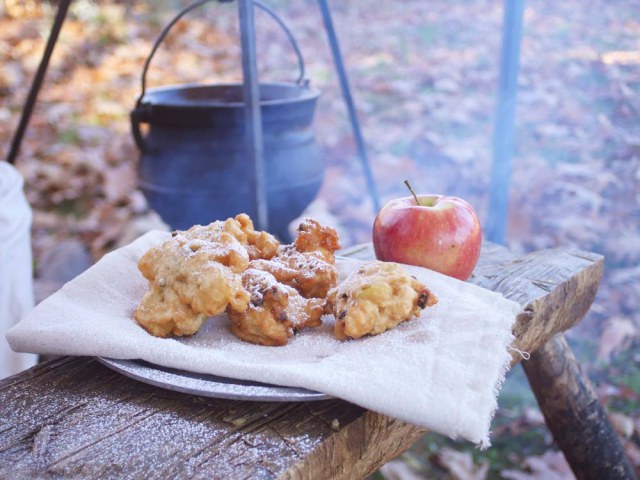
Here’s a recipe that was apparently popular enough that it was copied almost verbatim in several 18th century cook books. It’s a recipe for fritters. A fritter, also occasionally called a fraze, was a fried pastry, like a doughnut. They were either skillet fried or deep fried. The batter could be thin or thick — more like a dough. This particular recipe was exquisitely simple, calling for only four to five ingredients.

Here is Hannah Glasse’s copy from the 1774 edition of her cookbook, The Art of Cookery.

Here is our adaptation, changing a few things up where necessary, but staying well within period-correct methods and techniques:

Hasty Fritters

Ingredients:
1 – 12oz. bottle of any Light* Ale or Hard Apple Cyder
approximately 2 cups All Purpose Flour
1/4 – 1/3 cups Zante Currants or 1 Apple (diced) or both

About 2-lbs Lard (or or other fat**, e.g., shortening or vegetable…

View original post 411 more words

Recipe for an Ancient Craft: Building a Viking Bowyer’s Workshop Part II

archaeofox's avatarArchaeoFox: Exploring the World Through the Past

I stood outside the barn and with both hands, pressed against its enormous red doors; the flakes of paint coming off and sticking to my fingers as I entered. The bow staves we ordered the previous year had arrived the day before I left Lofoten, but I was assured that they were now safely tucked away somewhere in the barn; ‘somewhere’.

I walked inside, but the year had made me forget how big it was. Filled in every corner of its wooden walls were the artefacts of a museum’s long history. Many tar stained ropes looked down at me as I stepped over a couple of old rowing oars. They were leaning against a crooked table that was neatly set with rusty tools, a half closed bucket of paint and a Coke bottle, oranged from the linseed oil. I spotted the shape of a large, straw archery target that stood out from the shadows in the back; tattered and…

View original post 2,588 more words

A Workshop Fit For a Chieftain: Building a Viking Bow-maker’s Workshop – Part I

archaeofox's avatarArchaeoFox: Exploring the World Through the Past

Vegard Kaasen Engen, the Lofotr Viking Museum’s conservator and I stood back and inspected the new bow-making station; an assortment of wooden benches and iron tools displayed in the far corner of a long and wide room at the farthest end of chieftains’s longhouse. “Do you think it will hold?” he asked as I drove my last nail through the leg of a workbench and into the wooden floor. “Should do”, I said, giving it a sturdy wiggle. “Good, because its staying there,” he said with a grin; “indefinitely”. Not a year has passed since that conversation and already my entire workshop is being moved, along with all its fixtures, to the entire opposite end of the Chieftain’s Longhouse; to the room where an excavation in the 1980’s revealed around a large deposit of charcoal, several signs of domestic work, cooking, eating and sleeping; to the room we call the ‘Living Quarter’. Change is often inevitable…

View original post 2,133 more words